

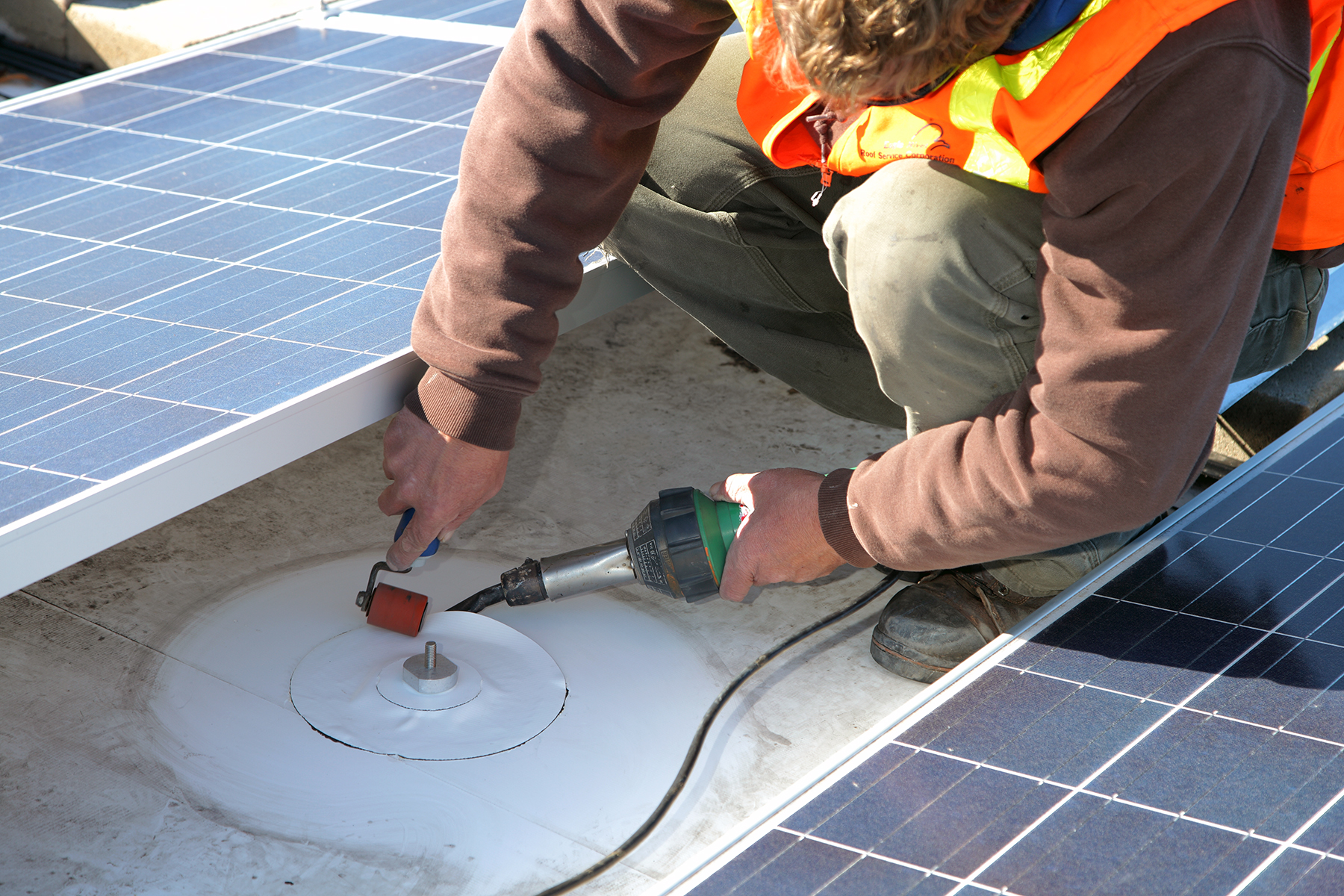
Solar-Ready Commercial Roofing & PV Integration
Solar-ready commercial roofing in Charlotte, NC. We handle PV racking penetrations, membrane compatibility, structural and uplift loads, and the warranty handoff between roofer and solar installer.
Solar-Ready Commercial Roofing & PV Integration
Solar-ready commercial roofing in Charlotte, NC. We handle PV racking penetrations, membrane compatibility, structural and uplift loads, and the warranty handoff between roofer and solar installer.
Solar-Ready Commercial Roofing & PV Integration work starts with a documented roof walk and ends with a scope owners can use.
The roof is the part of a solar project nobody budgeted for A photovoltaic array is a 25-year piece of equipment, and somebody is about to bolt it to your roof.
That single sentence is the whole reason owners call us before they sign a solar contract.
Out along the Steele Creek distribution corridor near Charlotte Douglas International, and across the manufacturing and flex space toward the University Research Park on US-29, we keep finding arrays that were dropped onto membranes with only a handful of years left in them.
When that membrane gives out, the array does not move itself.
A crew has to de-energize the system, lift the panels and racking off, stage them somewhere, replace the roof, and reset everything.
On a mid-size Charlotte warehouse that surprise can run well into five figures, and it is completely avoidable if the roof is dealt with first.
We sit on the roofing side of this, and we do not earn anything on the solar contract.
That is exactly why owners trust our read: we tell you whether the deck and membrane are actually ready to host an array, or whether you are about to spend solar money on a roof that is going to fail underneath it.
What has to be true before panels go up Three questions decide whether a roof is solar-ready, and a solar proforma almost never asks any of them because it treats the roof as a free, permanent platform.
Does the membrane have the life to carry a 25-year array?
We core-cut the roof and run an infrared moisture survey to see whether the field is dry and how many years it really has left.
A roof with fifteen-plus dry years is a candidate to build on.
Planning Solar-Ready Commercial Roofing & PV Integration
Solar-Ready Commercial Roofing & PV Integration should be evaluated through the roof condition, the building use, the owner's timing, and the level of documentation needed to make a decision.
The written record should make the next step clear without relying on broad claims or generic sales language.
Scope questions to answer early
Before a final scope is written for Solar-Ready Commercial Roofing & PV Integration, the building owner should understand what roof areas were observed, what areas were not accessible, what assumptions are being made, and what conditions could change the price or schedule after work begins.
That includes active leak locations, ponding water, interior sensitivity, roof traffic, parapet and edge conditions, equipment curbs, drain condition, prior repairs, membrane age, substrate concerns, and whether the roof has already been recovered before.
Documentation that makes the proposal useful
A useful commercial roof proposal should do more than name a material and a price. It should describe the problem being solved, the areas included, the exclusions, the access plan, the safety or tenant constraints, and the closeout documents the owner should receive.
For Solar-Ready Commercial Roofing & PV Integration, that documentation should connect back to the related service, system, capability, industry, property type, or location pages on this site so the owner can compare the decision against nearby roof paths instead of reading the page in isolation.
Maintenance and lifecycle planning
Even when the immediate work is a repair, the roof still needs a maintenance path. Drains need to remain clear, flashings need periodic checks, rooftop equipment work should be recorded, and any patched areas should be revisited after heavy weather.
For replacement, recover, or coating work, the maintenance plan becomes part of the lifecycle value. A roof that is documented at closeout and revisited on a schedule is easier to defend when warranty questions, future budgets, or property transactions come up.
How this page connects internally
Use roof work pages to compare specific scopes, roof system pages to compare assemblies, capability pages to understand reporting and planning support, and service area pages to keep the Charlotte context clear.
That internal structure is intentional. A commercial roof decision usually needs more than one page: the condition, the building type, the system, the service path, the documentation requirement, and the local access picture all work together.
What should happen before work starts
Before crews mobilize, the building should have a clear access plan, a communication point of contact, a weather plan, a material staging plan, and a way to protect tenants, inventory, equipment, or daily operations below the roof.
For Solar-Ready Commercial Roofing & PV Integration, those pre-work details are part of the roof scope because they affect safety, schedule, cleanup, and whether the work can be completed without avoidable disruption to the commercial property.
Closeout and next-step record
After the work is complete, the owner should receive a usable record: what was done, where it was done, what materials were used, what photos document the work, what warranty or maintenance notes apply, and what conditions should be watched later.
That closeout record is what keeps the next roof conversation from starting over. It gives future maintenance teams, property managers, buyers, lenders, or ownership groups a cleaner picture of the roof's condition and the decisions already made.
If the next step after Solar-Ready Commercial Roofing & PV Integration is not obvious, the safest path is to compare the condition record against repair, maintenance, coating, replacement, and system-selection pages before deciding how much work belongs in the current budget cycle. That comparison keeps the recommendation tied to the roof in front of the owner, and it keeps the final scope from drifting into work the building does not need.
Request a Written Scope